
Picture yourself walking into a 250-employee CFO meeting in late October. You brought your agency's sharpest credentials deck, and you ask who writes their medical plan, when it renews, and whether they like their current service.
Ten minutes in, the CFO glances at his watch. You sound just like the last four brokers who cold-called him this week.
Here's the painful part. Sixty days before that meeting, his incumbent broker quietly collected $96,480 in commissions and bonuses on that exact health plan. Even worse, $18,000 of that payout wasn't base commission at all. It was a supplemental bonus sitting on Schedule A, Part I, Line 3(c) of the company's own federal filing.
And it gets worse. While you were guessing renewal dates or clicking through 40-page government PDFs on the EFAST2 portal one EIN at a time, that public filing sat in plain sight. Or maybe you priced a legacy Form 5500 database, saw the $12,000+ annual price tag, and went back to cold lists. Every single week you prospect blind during renewal season, incumbent brokers keep cashing checks on accounts you should win.
So how do you flip the room before you even dial?
The October 15 extended Form 5500 filing deadline just closed, releasing the largest yearly wave of mid-market employer benefit disclosures. Instead of digging through raw PDFs, use Benny Data to search 700,000+ ERISA filings in plain English inside Claude, Grok, ChatGPT, Copilot, or Gemini, walking in with the carrier, headcount, renewal month, and broker pay verified.
In this guide, you will learn:
- Why Is October 15 the Real Starting Gun for Q4 Form 5500 Broker Prospecting?
- Where Do Incumbent Broker Commissions and Bonuses Hide on Form 5500 Schedule A Lines 1 to 3?
- How Do Schedule C Codes 22 and 53 Work with ERISA Section 408(b)(2)(B) in a Renewal Audit?
- How Can You Pull a Regional Form 5500 Broker Prospecting List in Seconds with Benny Data?
- Which Five Filing-Backed Questions Unseat Incumbent Brokers in a CFO Meeting?
- Frequently Asked Questions About Form 5500 Broker Prospecting
1. Why Is October 15 the Real Starting Gun for Q4 Form 5500 Broker Prospecting?
Form 5500 broker prospecting is the process of checking public Department of Labor (DOL) ERISA filings to see an employer's insurance carriers, covered headcount, policy renewal dates, and broker pay before making a sales call. Because calendar-year extensions expire on October 15, late October opens the freshest yearly batch of mid-market plan data for fourth-quarter and first-quarter renewals.
Most producers treat January 1 as the big date on the calendar. Smart producers circle October 15.
Here's why. Under federal rules in IRS Publication 5411, an employer plan must file its annual Form 5500 by the last day of the seventh month after the plan year ends. For a standard plan year ending December 31, that regular due date is July 31.
Very few mid-market plans file in July. Instead, thousands of employers send in IRS Form 5558 to get an automatic 2.5-month extension to October 15.
Under 29 CFR § 2520.104-20 in the DOL Form 5500 Instructions, unfunded or insured welfare plans with fewer than 100 participants at the start of the plan year are exempt from filing, while plans with 100 or more covered participants must file each year (and small pension plans follow 29 CFR § 2520.104-46). Build your list in August, and you get old prior-year numbers. Wait until after October 15, and the new numbers are live.
2. Where Do Incumbent Broker Commissions and Bonuses Hide on Form 5500 Schedule A Lines 1 to 3?
Incumbent insurance broker commissions, extra fees, and bonuses sit on Form 5500 Schedule A (Insurance Information), Part I, Lines 1 through 3. Every insured contract in a benefit plan gets its own Schedule A page, giving you a contract-by-contract breakdown of the carrier, covered lives, renewal date, and exact broker pay.
Many brokers stop after the first two pages of the main Form 5500, checking participant counts on Part II, Lines 5 and 6, and welfare codes on Line 8b (4A health, 4D dental, 4E vision), which tells you what benefits exist without telling you who gets paid. Use the FAB (Feature, Advantage, Benefit) lens on Schedule A, Part I:
- Lines 1(a) to 1(d) (Carrier Identity): Lists the carrier name, EIN, NAIC code, and contract number. You know the exact medical, dental, life, or stop-loss carrier before you dial.
- Line 1(e) (Covered Headcount): Reports the number of people covered at policy year-end. Compare two filings to spot growing employers.
- Lines 1(f) and 1(g) (Renewal Window): Lists the policy start and end dates (
12/31or01/31), so you can time outreach 60 to 90 days before renewal. - Line 2 (Total Broker Pay): Totals all commissions and fees paid on that contract. That lets you calculate cost per employee per month (PEPM) in seconds.
- Lines 3(a) to 3(e) (Base Pay vs. Bonuses): Line 3(a) names the brokerage firm. Line 3(b) shows sales and base commissions paid, and Line 3(c) shows fees and other commissions paid under DOL EBSA Advisory Opinion 2005-02A.
3. How Do Schedule C Codes 22 and 53 Work with ERISA Section 408(b)(2)(B) in a Renewal Audit?
For large plans with 100 or more participants, Form 5500 Schedule C (Service Provider Information), Part I, Item 2 requires employers to list every vendor paid $5,000 or more in direct or indirect pay during the plan year. Pairing Schedule C with the $1,000+ fee disclosure rule under ERISA Section 408(b)(2)(B) gives you a sharp compliance wedge.
What if the firm is self-funded? Schedule A tracks insured policies. Schedule C catches the rest.
In the official DOL Form 5500 Schedule C instructions, six codes show how an incumbent broker or advisor gets paid: Code 22 (insurance agents and brokers), Code 16 (plan consulting), Code 50 (direct payment from the plan), Code 53 (insurance brokerage commissions and fees), Code 64 (recordkeeping fees), and Code 65 (account maintenance fees).
Under ERISA Section 408(b)(2)(B) (explained in DOL EBSA Field Assistance Bulletin No. 2021-03), any group health broker or consultant who expects $1,000 or more in direct or indirect pay must give the plan sponsor a written fee disclosure before renewal:
- Step 1: Filter 100+ Participant Plans. Pull local employers with 100 to 1,000 covered lives on Schedule A Line 1(e) and a renewal date on Line 1(g).
- Step 2: Cross-Check Schedule A and Schedule C. Add up base pay on Schedule A Line 3(b), bonuses on Line 3(c), and pay under Schedule C Codes
22,16,50, or53. - Step 3: Bring a One-Page Audit to the CFO. Ask the CFO whether their broker's pre-renewal notice matches their public Schedule A and Schedule C numbers.
4. How Can You Pull a Regional Form 5500 Broker Prospecting List in Seconds with Benny Data?
You can pull a clean, filing-backed prospect list in seconds by linking the Benny Data MCP to Claude, Grok, ChatGPT, Copilot, or Gemini and asking a plain-English question across 700,000+ ERISA filings. Every answer cites the official DOL Form 5500, and you can export your table to a CSV file in one click.
Here is the Before and After (BAB) of your weekly prospecting block:
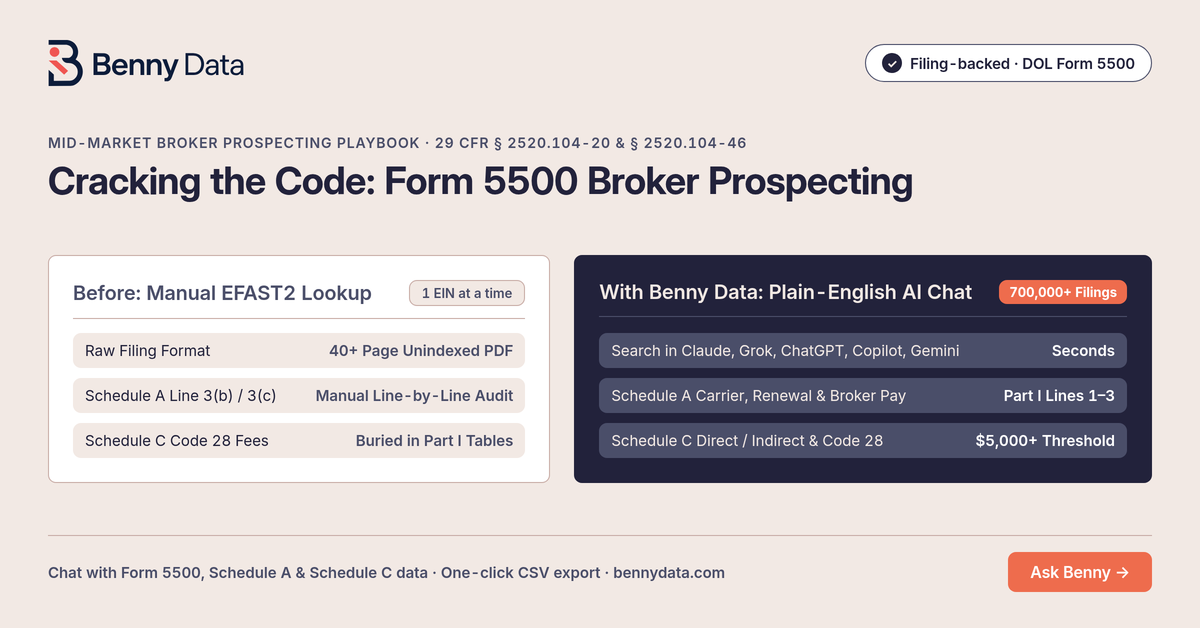
- Before Benny Data: You spend Friday afternoon typing employer names into the DOL EFAST2 search page. You download 40-page PDFs by hand, or you pay $12,000+ a year for a legacy database.
- After Benny Data: You open the AI chat assistant you already use. You type one plain-English question and receive a verified table of local renewal targets in ten seconds.
- The Bridge: Benny is the AI chat search and research tool for Form 5500 data. Copy and paste either prompt below inside Claude, Grok, ChatGPT, Copilot, or Gemini.
Ask Benny (Regional Prospect List): "Find employers in Denver, Colorado with 100 to 500 covered lives on Schedule A Line 1(e) whose latest Form 5500 shows more than $75,000 in broker pay on Schedule A Line 2. Show the sponsor name, covered lives, carrier, total broker pay (Schedule A Line 3b + Line 3c), implied PEPM cost, and renewal month from Schedule A Line 1(g), and export to CSV."
| Sponsor (Sample) | Plan / Filing Anchor | Covered Lives (Sched A Line 1e) | Primary Carrier (Sched A Line 1a) | Commissions + Fees (Sched A Line 3b + 3c) | Implied Broker Cost (PEPM) | Policy Renewal (Sched A Line 1g) | Official Filing Citation |
|---|---|---|---|---|---|---|---|
| Apex Precision Manufacturing Inc. (Sample) | Welfare Plan, Form 5500 + Sched A | 240 | UnitedHealthcare Insurance Co. | $96,480 ($78,480 base + $18,000 bonus/fees) | $33.50 PEPM | 12/31 (Jan 1 Renewal) | DOL Form 5500, Sched A Part I, Lines 1(e), 1(g), 2, 3(b)-(c) |
| Front Range Logistics Group LLC (Sample) | Health & Welfare Plan, Form 5500 + Sched A | 315 | Cigna Health & Life Insurance Co. | $117,180 ($117,180 base commission) | $31.00 PEPM | 12/31 (Jan 1 Renewal) | DOL Form 5500, Sched A Part I, Lines 1(e), 1(g), 2, 3(b) |
| Mile High Industrial Supply Co. (Sample) | Employee Benefit Plan, Form 5500 + Sched A | 165 | Kaiser Foundation Health Plan | $79,200 ($64,200 base + $15,000 supplemental fee) | $40.00 PEPM | 01/31 (Feb 1 Renewal) | DOL Form 5500, Sched A Part I, Lines 1(e), 1(g), 2, 3(b)-(c) |
✓ Filing-backed: Every row cites the official DOL Form 5500 Schedule A filing. Structured results export to CSV in one click.
Ask Benny (Single-Account Audit): "Compare the last two Form 5500 filings for [Prospect Sponsor Name]. Did their Schedule A Line 2 broker pay or Schedule C Code 22/53 compensation grow faster than covered lives on Schedule A Line 1(e)?"
5. Which Five Filing-Backed Questions Unseat Incumbent Brokers in a CFO Meeting?
Asking five sharp questions built from the prospect's own Form 5500 Schedule A and Schedule C filings shifts you from a broker begging for a quote to a trusted advisor reviewing their audit trail. Each question ties a public line item on the employer's filing to a real renewal decision:
- "Your latest Schedule A Line 3(c) lists extra fees and bonuses on top of the Line 3(b) base commission, so did your broker spell out those bonuses in your pre-renewal ERISA Section 408(b)(2)(B) disclosure?"
- "Your covered headcount on Schedule A Line 1(e) stayed flat over the last two filings while total broker pay on Line 2 jumped alongside rate hikes, so why does your broker get a raise every time your carrier raises rates?"
- "Your Schedule A Line 1(g) shows a January 1 medical renewal plus separate dental, vision, and stop-loss policies, so are you checking total broker pay across all attached Schedule A pages or only medical?"
- "On Schedule C Part I Item 2, your plan listed $5,000+ payments under Service Codes 22 and 53 next to direct consulting fees under Code 16, so how do you reconcile those payments against your service contract?"
- "Compared to peer employers of your size in the same metro area, your implied PEPM broker cost on Schedule A sits above the local average, so what specific clinical or compliance work are you receiving for that spend?"
Stop Prospecting Blind in Q4. Ask Benny Instead.
You don't need a $12,000+ legacy database or hours wasted pulling raw EFAST2 PDFs one EIN at a time. With Benny Data, you can search 700,000+ post-October 15 ERISA filings in plain English inside Claude, Grok, ChatGPT, Copilot, and Gemini, verify every number against the official DOL Form 5500, and export clean prospect lists to CSV in one click.
- Get 15 Free Searches Every Month: Start Free with Benny Data at bennydata.com/claim-free-tier
- Want Full MCP Access at One Low Flat-Rate Fee? Claim the Exclusive Offer at bennydata.com/claim-exclusive-offer
6. Frequently Asked Questions About Form 5500 Broker Prospecting
Where are insurance broker commissions reported on Form 5500?
Broker commissions and fees appear on Form 5500 Schedule A, Part I, Lines 2 and 3 for each insured contract. They also appear on Schedule C, Part I, Item 2 for large plans (100+ participants) when a vendor receives $5,000 or more in direct or indirect pay.
What is the difference between Form 5500 Schedule A Line 3(b) and Line 3(c)?
On Schedule A, Part I, Line 3(b) lists sales and base commissions paid to the named insurance agent or broker. Line 3(c) lists fees and other commissions paid, which covers supplemental fees, persistency bonuses, and profit bonuses under DOL Advisory Opinion 2005-02A.
When do extended calendar-year Form 5500 filings become public for prospecting?
Calendar-year benefit plans face a normal filing deadline of July 31 and an automatic 2.5-month extended deadline of October 15 when they file IRS Form 5558. That makes late October the best window of the year to check fresh filings before fourth-quarter and first-quarter renewals wrap up.
Which employers must file a Form 5500 for health and welfare plans?
Under 29 CFR § 2520.104-20 in the DOL Form 5500 Instructions, ERISA welfare benefit plans that cover 100 or more participants at the start of the plan year (or hold plan assets in a trust) must file a Form 5500 each year, while small pension plans follow 29 CFR § 2520.104-46.
How does Benny Data help brokers search Form 5500 filings faster?
Benny is the AI chat search and research tool for Form 5500 data. When you connect the Benny Data MCP to Claude, Grok, ChatGPT, Copilot, or Gemini, you can search 700,000+ ERISA filings in plain English, check every figure against the official DOL Form 5500, and export structured prospect lists to CSV in one click.